
Walk into any home improvement store or scroll through window and glass product ads, and you’ll see claims about “self-cleaning” glass, tiles, and paint. It sounds almost too good to be true — a surface that stays clean on its own, with little to no scrubbing needed. So what’s actually going on with these coatings, and do they hold up to the claims? The short answer: they work, but not quite the way the marketing suggests.
There Are Two Different Kinds of “Self-Cleaning”
Most people assume “self-cleaning” means one single technology. It’s actually two very different approaches, and knowing which one you’re dealing with matters.
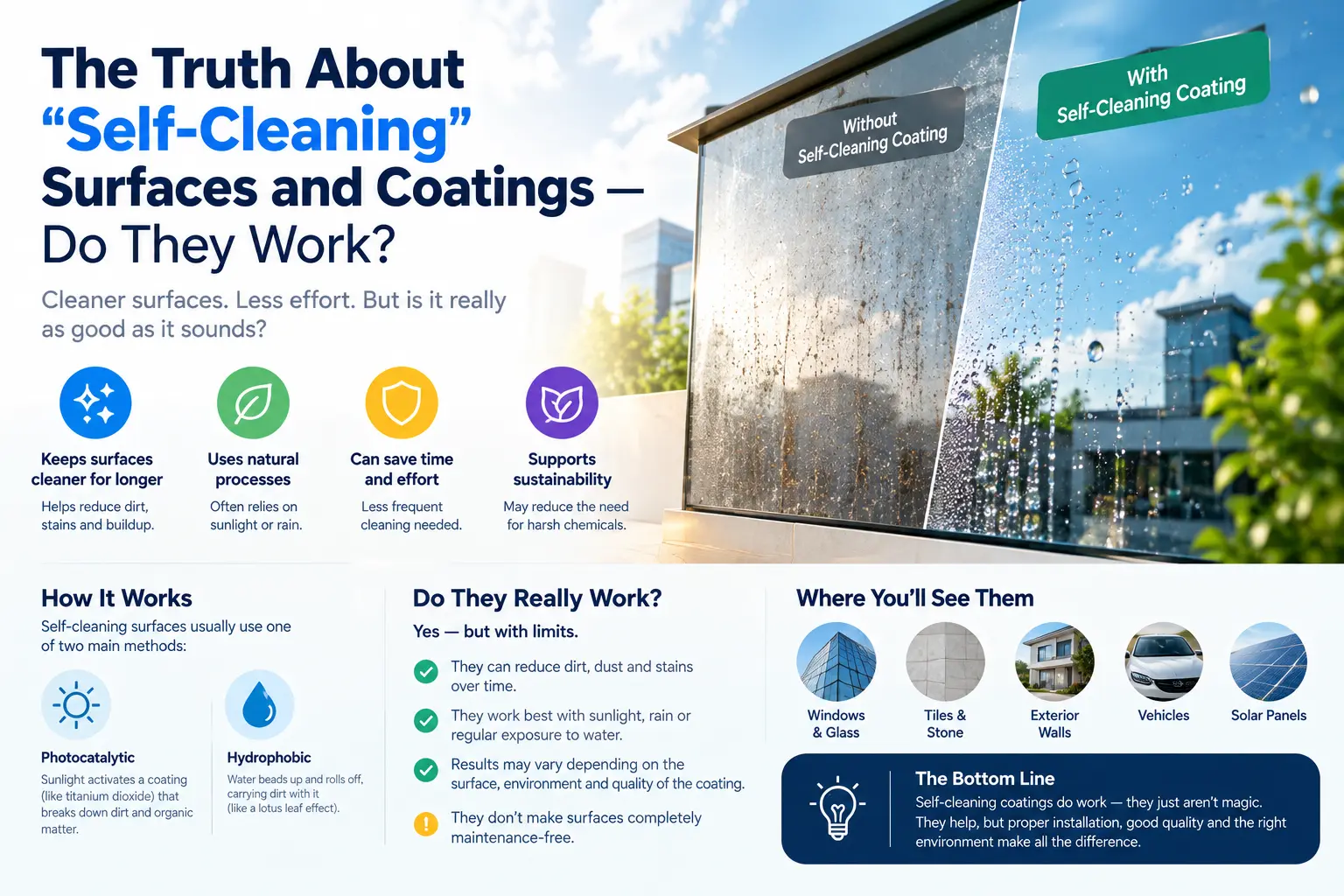
Water-repelling coatings. These push water away instead of letting it sit on the surface. The idea comes from nature — lotus leaves have a tiny, bumpy surface that makes water bead up and roll right off, carrying loose dirt with it as it rolls. Coatings built this way work the same way. Water forms tight drops, and as those drops roll off, they pick up dust along the way.
Light-activated coatings (photocatalytic). These use a compound, usually titanium dioxide, that reacts with sunlight (specifically UV light) to break down organic dirt sitting on the surface. At the same time, the coating pulls water into a thin, even sheet instead of beads, so when rain or a rinse comes along, it washes evenly across the surface and carries the broken-down grime away with it, rather than leaving streaky spots behind.
Self-cleaning glass, some exterior building coatings, and certain solar panel coatings tend to use this second approach, since it handles both organic buildup and rinsing in one process.
What They’re Actually Good At
Both types genuinely work — within limits. Water-repelling coatings are effective at reducing how much dust and light dirt sticks to a surface in the first place, and they make rinsing far more effective than it would be on an untreated surface. Light-activated coatings do something water-repelling coatings can’t: they actually break down organic grime chemically, not just repel it, which is part of why they’re popular for solar panels and glass facades that need to stay efficient and clear with minimal manual cleaning.
Used properly, these coatings can meaningfully cut down on how often — and how hard — you need to clean a treated surface.
Where the Marketing Oversells It
Here’s where the claims stretch further than reality:
They don’t eliminate cleaning — they reduce it. No coating removes 100% of what lands on a surface, especially mineral buildup, grease, or anything that isn’t “organic” dirt in the way the coating is designed to break down.
Light-activated coatings need actual sunlight to work. A photocatalytic coating is only as active as the UV exposure it gets. A shaded window, an indoor surface, or a cloudy stretch of weather simply won’t trigger the same self-cleaning reaction advertised on the box.
The effect wears off over time. Both types of coatings degrade with exposure to weather, abrasion, and general wear. Studies on these coatings consistently point to durability as one of their biggest weaknesses — the self-cleaning effect often fades well before the surface itself needs replacing, which means the coating needs reapplication to keep working as advertised.
They’re picky about what they clean. A coating optimized for one kind of residue (oily, organic grime, for example) may do very little against a different kind (hard water mineral deposits, for example). No single coating handles everything equally well.
Why This Matters Even More in Dubai
These coatings sell well here, and for good reason — but Dubai’s weather tests their limits hard. Fine dust in the air, plus the odd sandstorm, builds up fast, and water-repelling coatings were not built to beat that kind of buildup on their own. Dubai’s hard water also leaves mineral marks that most self-cleaning coatings, of either kind, are not built to break down. In short, a self-cleaning window in Dubai will likely need less cleaning than a plain one. But less often is a long way from never. In other words: a self-cleaning window in Dubai will likely need less frequent cleaning than an untreated one, but “less frequent” is a long way from “never.”
The Honest Verdict
Self-cleaning coatings aren’t a scam, but they’re also not a replacement for a proper cleaning routine. Think of them as a genuine assist — reducing buildup and making the cleaning you do still need far easier and less frequent, rather than making cleaning unnecessary altogether. The surfaces that benefit most (large glass facades, solar panels, hard-to-reach exterior areas) are exactly the ones where even a partial reduction in manual cleaning makes a real difference.
For everything else — counters, floors, bathroom fixtures, and the everyday surfaces inside your home — there’s still no substitute for a thorough, properly done clean.
At Alo Maids, we know the difference between what a coating can genuinely handle and what still needs real, hands-on attention — and we treat every surface in your home accordingly, not based on what the packaging promised.
Ready for cleaning that doesn’t rely on marketing claims to get the job done? Book your appointment with Alo Maids today.