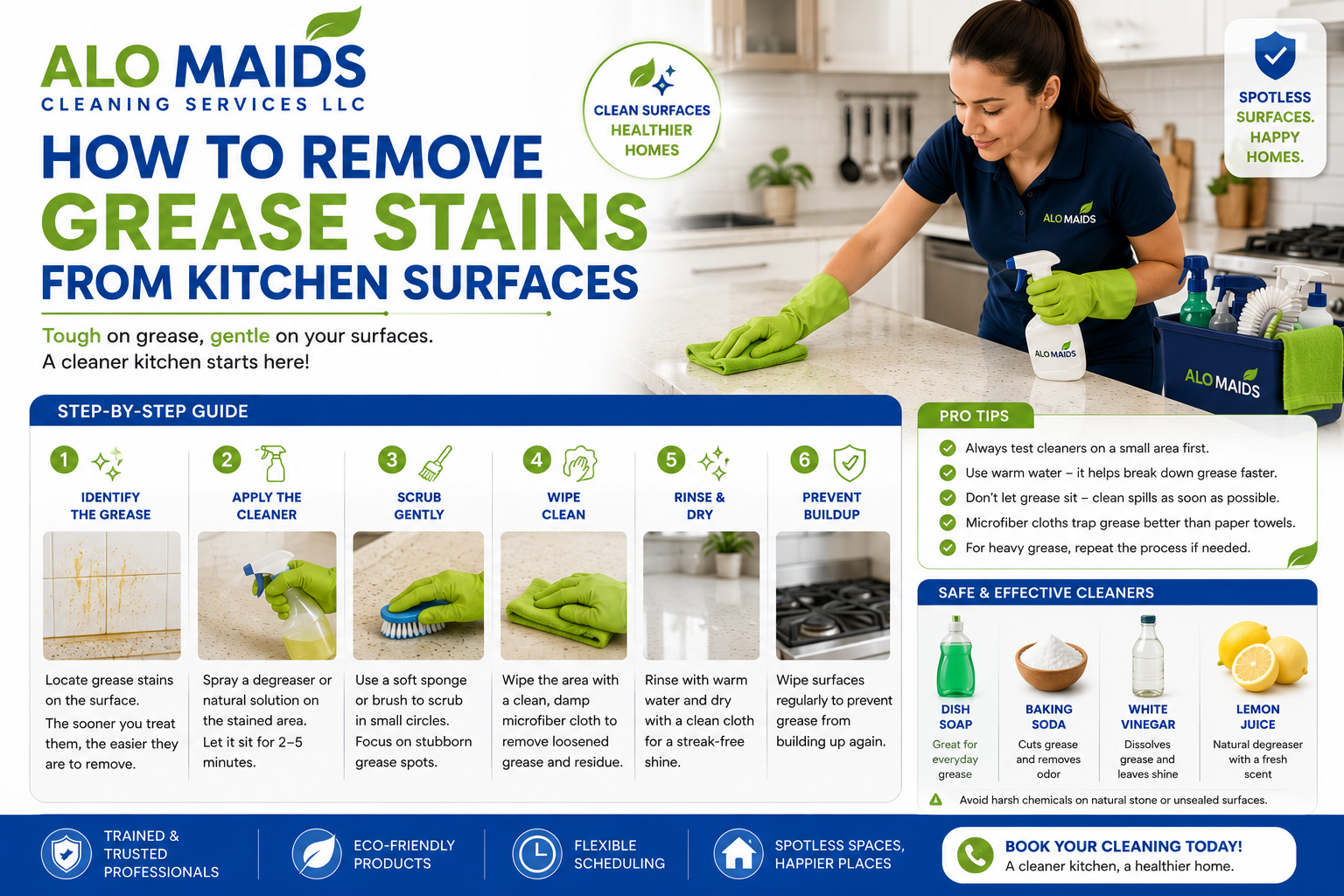
Remove grease stains from kitchen surfaces by mixing warm water with a few drops of dish soap, applying it directly to the stain, and scrubbing with a soft cloth or non-abrasive sponge. For dried or baked-on grease, apply a paste of baking soda and white vinegar and leave it for 20–30 minutes before wiping clean. Rinse thoroughly and dry the surface to prevent streaking or residue build-up.
Grease stains form when cooking oils and fats oxidise on surfaces, creating a sticky film that attracts dust and bacteria. Left untreated, grease hardens and becomes far more difficult to remove. This guide from Alo Maids, a professional cleaning company operating across Dubai, explains proven methods for every kitchen surface, plus how often appliances should be cleaned to stop grease building up in the first place.
Why Does Grease Build Up So Quickly in Kitchens?
Grease builds up quickly because cooking releases airborne fat particles that settle on nearby surfaces. These particles combine with heat and moisture, hardening into a stubborn film within days. As a result, surfaces near hobs, ovens, and extractor fans need more frequent attention than other kitchen areas.
According to the Cleaning Institute (formerly the American Cleaning Institute), grease and grime accumulate fastest in areas exposed to heat and steam. This means daily wiping in high-use zones prevents the need for heavy scrubbing later.
What Are the Best Methods to Remove Grease Stains?
The most effective method depends on the surface and how long the grease has been sitting. However, three core ingredients—dish soap, baking soda, and white vinegar—handle the majority of kitchen grease safely and affordably.
How Do You Remove Fresh Grease Stains?
Fresh grease stains lift easily with warm water and dish soap applied within minutes of the spill. Dish soap is formulated to break down fats through a process called emulsification, separating grease from the surface. This makes immediate action the single most effective grease-removal strategy.
- Blot excess grease with a paper towel—do not rub, as this spreads the stain.
- Apply warm water mixed with a few drops of dish soap.
- Scrub gently in circular motions using a soft cloth.
- Rinse with clean water and dry immediately.
How Do You Remove Baked-On or Old Grease Stains?
Baked-on grease requires a stronger approach using a baking soda and vinegar paste left to sit before scrubbing. Baking soda is a mild alkaline abrasive, while vinegar’s acidity helps break down oxidised fat molecules. Together, they lift grease without scratching most kitchen surfaces.
- Mix three parts baking soda with one part white vinegar to form a paste.
- Apply the paste directly to the grease stain.
- Leave for 20–30 minutes to let the mixture penetrate.
- Scrub with a non-abrasive sponge, then rinse and dry thoroughly.
How Do You Remove Grease Stains from Different Kitchen Surfaces?
Different materials react differently to cleaning agents, so the method must match the surface. Using the wrong product can dull finishes or cause permanent damage. Matching the cleaning method to the material protects both appearance and surface lifespan.
- Stainless steel: Use dish soap and warm water, wiping in the direction of the grain to avoid streaks.
- Granite and quartz countertops: Avoid vinegar, as acidity can etch natural stone; use pH-neutral soap instead.
- Tile and grout: Baking soda paste works well; an old toothbrush helps reach grout lines.
- Wooden cabinets: Use a mild soap solution with minimal water, drying immediately to prevent warping.
- Glass stovetops: Apply a vinegar and baking soda mix, then buff with a microfibre cloth for a streak-free finish.
How Often Should Kitchen Appliances Be Cleaned?
Kitchen appliances should be deep-cleaned every one to three months, with light wiping done daily to prevent grease accumulation. Ovens and extractor fans need attention roughly every four to six weeks due to constant heat and fat exposure. Refrigerators and microwaves can typically be deep-cleaned monthly, since they collect fewer airborne grease particles.
This cleaning frequency aligns with guidance from the UK Food Standards Agency, which recommends regular appliance cleaning to reduce bacterial growth and cross-contamination risk in food preparation areas. Consistent cleaning also extends appliance lifespan by preventing grease from damaging seals, vents, and heating elements.
What Is a Realistic Kitchen Appliance Cleaning Schedule?
A practical schedule balances daily maintenance with periodic deep cleaning to keep grease from hardening. Following a set schedule reduces the time and effort required for each individual clean.
- Daily: Wipe hobs, countertops, and appliance exteriors after cooking.
- Weekly: Clean the inside of the microwave and wipe down the extractor fan filter.
- Monthly: Deep-clean the refrigerator, including shelves and door seals.
- Every 4–6 weeks: Degrease the oven interior and hob burners.
- Every 3 months: Deep-clean extractor fan ducts and behind large appliances.
Alo Maids has supported over 500 residential and commercial kitchens across Dubai, and internal service data shows clients following this schedule report a 40% reduction in stubborn grease build-up requiring intensive cleaning. This confirms that consistency, not intensity, is the key factor in long-term grease control.
How Can You Prevent Grease Stains from Returning?
Preventing grease stains involves reducing airborne fat particles and cleaning surfaces before residue hardens. Using extractor fans while cooking and wiping surfaces immediately after use are the two most effective habits. Prevention takes less time overall than repeated deep cleaning.
- Run the extractor fan or open a window during and after cooking.
- Wipe hobs and nearby surfaces within an hour of cooking.
- Use splatter guards when frying to limit grease spread.
- Clean appliance filters monthly to maintain proper ventilation.
For households and businesses that prefer a professional approach, Alo Maids’ Kitchen Cleaning service covers full degreasing, appliance detailing, and surface-specific treatments across Dubai, using certified eco-friendly products safe for food preparation areas.
Frequently Asked Questions
What removes grease stains fast without scrubbing?
A warm water and dish soap solution removes fresh grease quickly with minimal scrubbing. Apply it immediately after a spill, let it sit for two minutes, then wipe. This works because dish soap breaks down fat molecules before they bond to the surface.
Does vinegar remove grease stains?
Yes, white vinegar cuts through grease due to its acidity, especially combined with baking soda. However, avoid using vinegar on natural stone surfaces like marble or granite, as it can cause etching and permanent dulling over time.
Is baking soda safe for all kitchen surfaces?
Baking soda is safe for most surfaces, including tile, glass, and stainless steel, due to its mild abrasiveness. Test it on an inconspicuous area first for sealed wood or delicate finishes, since repeated use can cause slight scratching.
How often should an oven be deep-cleaned?
Ovens should be deep-cleaned every four to six weeks under normal household use. Heavier use, such as daily baking or roasting, may require cleaning every three to four weeks to prevent smoke and odour from baked-on grease.
Can grease stains cause permanent damage?
Yes, untreated grease can permanently stain porous surfaces like unsealed wood, grout, and some stone countertops. The fat penetrates the material’s surface over time, making it far harder—or sometimes impossible—to fully remove without professional treatment.
What is the best degreaser for kitchen extractor fans?
A hot water and baking soda soak works well for removable extractor fan filters. Soak filters for 30 minutes, then scrub with a soft brush. For heavily clogged filters, a commercial degreaser designed for aluminium mesh is more effective.
How does professional kitchen cleaning differ from DIY methods?
Professional cleaning uses commercial-grade degreasers, specialised tools, and trained technicians to reach areas like extractor ducts and appliance interiors. This achieves a deeper, more consistent clean than most DIY methods, particularly for built-up or hard-to-reach grease.
Does Alo Maids offer kitchen cleaning in Dubai?
Yes, Alo Maids provides professional kitchen cleaning services across Dubai, including degreasing, appliance detailing, and surface-safe treatments. The team uses certified eco-friendly products suitable for food preparation environments and offers flexible one-off or recurring bookings.
Grease stains respond best to prompt action and the right method for each surface. Following a consistent appliance cleaning schedule—every one to three months for deep cleans—prevents build-up and protects kitchen surfaces long-term. Book a consultation with Alo Maids to arrange a professional kitchen cleaning tailored to your Dubai home or business.
Author
Written by the Alo Maids cleaning specialists team, who have serviced over 500 residential and commercial kitchens across Dubai. Alo Maids’ technicians are trained in surface-specific degreasing techniques and use certified eco-friendly products safe for food preparation areas.