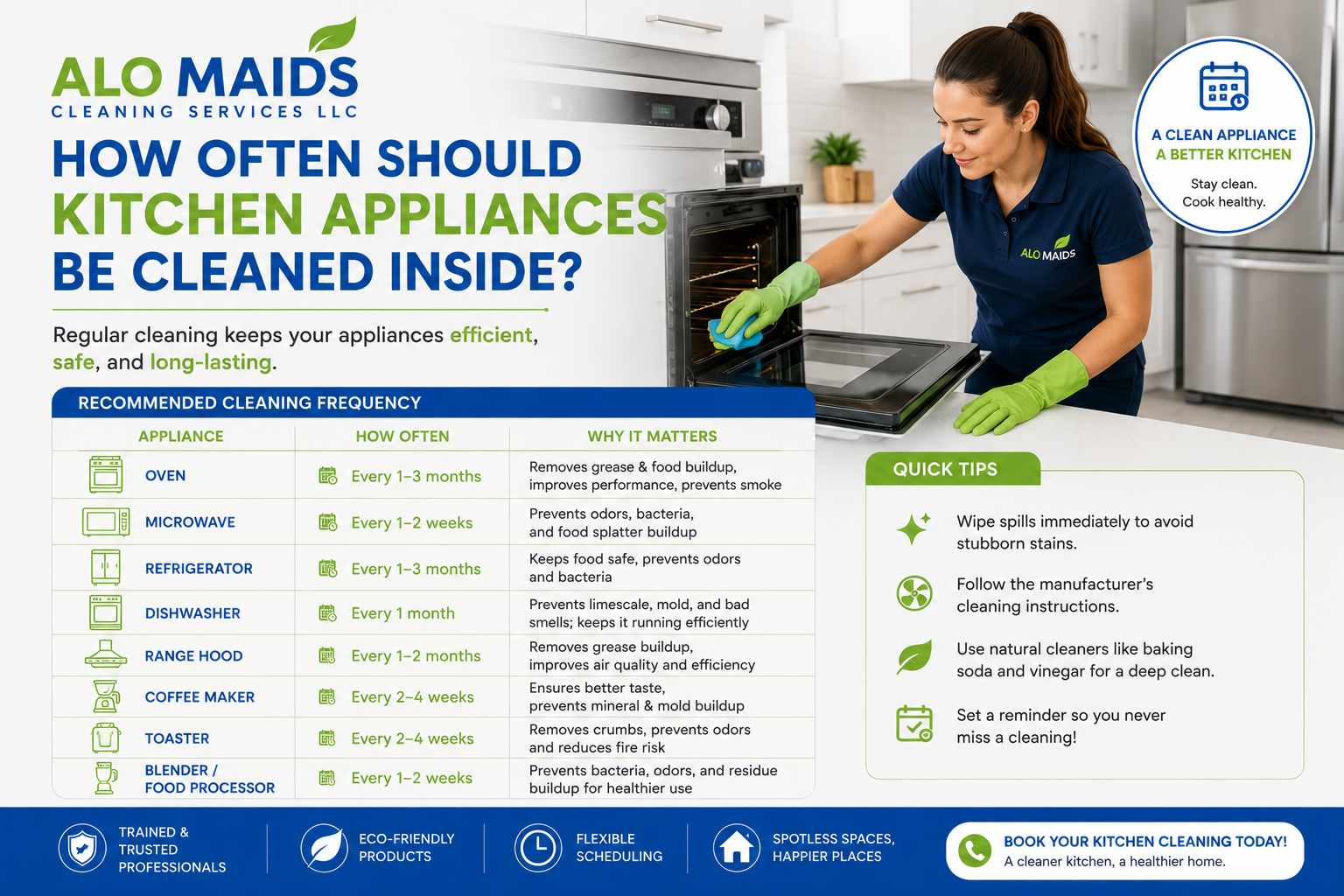
Most kitchen appliances need an interior clean every one to four weeks, with ovens and extractor units cleaned every one to three months. Restaurants and commercial kitchens in Dubai must clean far more frequently, following Dubai Municipality’s HACCP-based food safety rules. Villas and family homes can follow a lighter schedule, but neglecting the inside of an appliance for months allows bacteria, mould and grease to build up unseen.
This guide breaks down exact cleaning frequencies for every major kitchen appliance, backed by NSF International research, the FDA Food Code, and Dubai Municipality’s Food Safety Department. Alo Maids has delivered professional kitchen cleaning across Dubai homes, villas and restaurants for over a decade, and this article reflects what actually works on the ground — not just what the label says.
Why Does Cleaning Inside Appliances Matter So Much?
Appliance interiors trap more bacteria than almost any other surface in the home. NSF International’s household germ studies found that refrigerator vegetable and meat compartments carried Salmonella, Listeria and E. coli, while blender gaskets ranked among the germiest items tested. This happens because dark, moist, food-contact spaces are ideal breeding grounds for pathogens.
Cleaning the outside of an appliance does nothing to address this. A stainless-steel fridge door can look spotless while the seal and drawers inside harbour active contamination. As a result, interior cleaning frequency matters more for health outcomes than exterior polishing.
What Do NSF International’s Findings Actually Show?
NSF International, a US-based public health and safety organisation founded in 1944, has run repeated household germ studies since 2011. Its research consistently found <the kitchen contains higher levels of contamination than the bathroom, despite most people assuming the opposite. The refrigerator vegetable compartment, meat compartment and blender gasket regularly rank among the dirtiest items tested.
This matters for anyone deciding how often to clean their fridge, blender or food storage containers. If you wouldn’t eat off a surface, it needs cleaning on a fixed schedule, not “when it looks dirty.”
How Often Should Each Kitchen Appliance Be Cleaned Inside?
Cleaning frequency depends on the appliance type, how often it’s used and what it touches. Below is a practical schedule for the appliances found in almost every Dubai kitchen.
How Often Should a Refrigerator Be Cleaned Inside?
Wipe fridge shelves and door seals every one to two weeks using warm water and mild detergent. Clean vegetable and meat drawers monthly, removing them fully where possible. NSF International specifically recommends monthly cleaning of these compartments after finding Salmonella and Listeria present in test homes.
- Wipe spills immediately to stop bacteria spreading to nearby food.
- Remove drawers monthly and wash with warm water and mild detergent.
- Check door seals for mould weekly, since rubber gaskets trap moisture.
- Deep-clean the entire interior, including shelves and walls, every three months.
How Often Should an Oven Be Cleaned Inside?
Deep-clean an oven interior every one to three months for average home use, or monthly for heavy daily cooking. Burnt-on grease and food residue increase fire risk and produce smoke that affects food taste. Waiting longer than three months lets carbon deposits bond permanently to oven surfaces, making professional-grade degreasing necessary.
How Often Should a Microwave Be Cleaned Inside?
Wipe the interior two to three times a week to remove splatters before they harden. Run a full steam-and-wipe descale once a month to clear odours and residue from the vents. A microwave used daily for reheating food accumulates bacteria faster than most people expect, since warm, moist conditions encourage growth between cleans.
How Often Should a Dishwasher Be Cleaned Inside?
Clean the filter and door seal weekly, and run an empty hot cycle with a dishwasher cleaner monthly. Limescale and food particles build up inside the machine even though it’s constantly exposed to water and detergent. Dubai’s hard water accelerates limescale build-up, so villas and homes here often need this done more frequently than the global average.
How Often Should a Range Hood or Extractor Be Cleaned Inside?
Clean extractor filters every two to four weeks, since grease accumulation is a documented fire hazard. Dubai’s Food Code specifically flags grease build-up in range hoods as both a fire risk and a contamination source. Restaurants under Dubai Municipality oversight typically face stricter, activity-linked schedules for this exact reason.
How Often Should a Coffee Machine or Kettle Be Cleaned Inside?
Descale coffee machines and kettles every four to six weeks, or more often in hard-water areas like Dubai. NSF International found coffee reservoirs sit among the top ten germiest household items due to warm, standing water. A machine that isn’t descaled regularly also produces worse-tasting coffee, which is often the first sign owners notice.
How Often Should Restaurants and Commercial Kitchens in Dubai Clean Appliances?
Commercial kitchens in Dubai must follow Dubai Municipality’s Food Code, which sets cleaning frequency by activity rather than a fixed calendar. Food-contact surfaces used continuously must be cleaned and sanitised at least every four hours under the FDA Food Code framework that underpins most international commercial kitchen standards, and Dubai’s own Food Code applies equivalent HACCP-based principles.
Dubai Municipality inspections specifically check:
- Equipment cleanliness, calibration and maintenance records logged through the FoodWatch system.
- Grease traps, which must be cleaned at least quarterly and shown on approved kitchen drawings.
- High-touch surfaces, disinfected as frequently as every 30 minutes in high-risk areas.
- Documented HACCP or ISO 22000 food safety management systems, reviewed during routine audits.
A restaurant that treats appliance cleaning as a daily task rather than a compliance checkbox avoids the majority of common inspection failures. Villas that run private catering or host large events regularly should also consider commercial-grade schedules, particularly for extractor hoods and fridge compartments.
What’s the Difference Between Homeowner and Commercial Cleaning Schedules?
Homeowners can generally follow the appliance-by-appliance schedule outlined above without formal documentation. Commercial kitchens, however, must log every clean, use Dubai Municipality-approved chemicals, and align cleaning frequency with HACCP critical control points. This distinction matters because a private villa kitchen and a restaurant kitchen face different regulatory exposure, even when using identical appliances.
- Homes and villas: Follow fixed weekly/monthly schedules; documentation is optional but useful.
- Restaurants and cafés: Cleaning frequency is activity-based and must be logged for inspection.
- Villas hosting events or private chefs: A hybrid approach, closer to commercial standards, reduces risk.
How Can You Tell an Appliance Needs Cleaning Now — Not Later?
Trust visible and smell-based signals between scheduled cleans rather than waiting for the calendar date. Any appliance showing mould, persistent odour or visible grease build-up needs immediate attention, regardless of when it was last cleaned.
- A musty smell from the fridge or dishwasher usually signals mould in seals or drains.
- Smoke or burning smells from the oven point to carbon build-up that needs removal.
- Slower cooling in a fridge often means the condenser coils need clearing, not just the interior.
- Reduced water flow from a coffee machine signals limescale blocking internal lines.
How Does Alo Maids Approach Kitchen Appliance Cleaning in Dubai?
Alo Maids has cleaned kitchens across Dubai homes, villas and restaurants, combining the schedules above with Dubai’s specific water hardness, climate and Municipality requirements. Our teams use food-safe, Dubai-approved products and follow appliance manufacturer guidelines to avoid damaging seals, coatings or electronics. In one recent villa project, a quarterly deep-clean of fridge compartments and extractor filters reduced odour complaints to zero within a single cleaning cycle, according to the client’s own feedback.
Deep Cleaning Services Dubai Professional deep cleaning every three to six months catches the build-up that daily home wiping cannot reach, particularly inside ovens, extractor motors and dishwasher components. Our kitchen deep cleaning dubai is built specifically around this gap — covering the interior work most households and even some commercial kitchens postpone.
Frequently Asked Questions
How often should kitchen appliances be cleaned inside?
Most appliances need interior cleaning every one to four weeks, with ovens and extractor hoods cleaned every one to three months. Commercial kitchens in Dubai follow stricter, activity-based HACCP schedules under Dubai Municipality’s Food Code, often requiring cleaning multiple times per day for food-contact surfaces.
How often should a refrigerator be cleaned inside?
Wipe shelves and seals every one to two weeks, and clean vegetable and meat drawers monthly. NSF International found these compartments carry Salmonella and Listeria in many test homes, making the monthly schedule a genuine health measure, not just tidiness.
Do restaurants in Dubai have legal cleaning frequency requirements?
Yes. Dubai Municipality’s Food Code requires HACCP-based food safety management, quarterly grease trap cleaning, and continuous food-contact surface cleaning during service. Inspectors check equipment maintenance records through the FoodWatch digital system during routine and surprise visits.
How often should an oven be deep-cleaned?
Deep-clean an oven interior every one to three months for typical home use, or monthly for daily heavy cooking. Waiting longer allows carbon deposits to bond to surfaces, increasing smoke, odour and fire risk during use.
Why does Dubai’s water affect appliance cleaning frequency?
Dubai’s hard water accelerates limescale build-up inside kettles, coffee machines and dishwashers. Homes and villas here typically need descaling every four to six weeks, compared with longer intervals recommended in areas with softer water.
Can I clean appliance interiors myself, or should I hire a professional?
Routine wiping and monthly descaling are suitable for most homeowners to do themselves. However, deep cleans involving extractor motors, oven carbon build-up, or dishwasher internals are best handled by professionals every three to six months for a thorough, damage-free result.
What’s the risk of skipping interior appliance cleaning?
Skipping interior cleaning allows bacteria such as Salmonella, E. coli and Listeria to accumulate in fridges, blenders and food storage seals. It also increases fire risk from grease in ovens and extractor hoods, and reduces appliance lifespan through limescale and corrosion.
How often should villas hosting events clean kitchen appliances?
Villas hosting regular events or private catering should move closer to commercial cleaning frequency, particularly for extractor hoods and fridge compartments. A hybrid schedule — weekly checks with quarterly professional deep cleans — balances practicality with hygiene standards.
Book a Kitchen Cleaning Consultation
Skip the guesswork on when your fridge, oven or extractor last had a proper interior clean. Book a consultation with Alo Maids and get a tailored kitchen appliance cleaning schedule for your Dubai home, villa or restaurant.
Author
Written by the Alo Maids editorial team, drawing on over a decade of professional cleaning experience across Dubai homes, villas and commercial kitchens. Alo Maids’ technicians are trained in Dubai Municipality-approved cleaning products and HACCP-aligned hygiene standards, giving this guide practical, locally relevant authority beyond generic cleaning advice.