Key Takeaways
- A full kitchen deep clean covers appliances, cabinets, grout, and hidden grease zones — not just visible surfaces.
- Start top to bottom, clean inside appliances first, and finish with floors last.
- The kitchen sponge is the germiest item in most homes, according to NSF International — replace it weekly.
- Dubai’s heat and dust levels mean AC vents and window tracks need extra attention during a kitchen deep clean.
- Professional deep cleans typically take 3–5 hours for an average Dubai apartment kitchen, depending on grease build-up.
To deep clean a kitchen, work through five zones in order: appliances, cabinets and surfaces, sink and taps, floors and grout, and high-touch areas like handles and switches. Use degreasers on cooking surfaces, disinfectant on food-contact areas, and finish with floors last. A full deep clean of an average Dubai kitchen takes between three and five hours when done thoroughly.
Regular wiping keeps a kitchen looking tidy, but it does not remove the grease film, bacteria, and dust that build up behind appliances and inside cabinets. Deep cleaning means a scheduled, thorough clean that reaches every surface a normal wipe-down skips. Dubai’s climate makes this more important than in most cities, because fine dust and high humidity accelerate grime build-up in kitchens.
This guide walks through the exact process Alo Maids‘ teams use across residential kitchens in Dubai, from Downtown apartments to Arabian Ranches villas. Every step below is written so you can follow it yourself, or use it to understand what a professional deep clean should include.
Why Does a Kitchen Need Deep Cleaning, Not Just Regular Cleaning?
A kitchen needs deep cleaning because grease, bacteria, and food residue collect in places daily wiping cannot reach. Regular cleaning handles counters and floors; deep cleaning handles the inside of ovens, behind appliances, and inside cabinets.
The kitchen is not the room most people assume is dirtiest. NSF International, a public health and safety organisation, swabbed 30 household items and found the kitchen harboured more bacteria than the bathroom in most homes tested. Sponges, sinks, and cutting boards ranked among the highest sources of coliform bacteria, a group that includes E. coli and Salmonella.
In Dubai specifically, three factors accelerate the need for deep cleaning:
- Fine outdoor dust settles inside cabinets and on top of units within weeks, even with windows closed.
- High humidity during summer months speeds up mould growth in damp corners and under sinks.
- Heavy use of AC circulates dust onto kitchen surfaces faster than in drier climates.
A kitchen that looks clean can still carry significant bacterial load on sponges, taps, and cutting boards.
What Do You Need Before Starting a Kitchen Deep Clean?
Gather all supplies before starting, since stopping partway through a task like oven cleaning wastes time and product. Most kitchens need a degreaser, a disinfectant, microfibre cloths, and a few specialist tools.
Recommended supply list:
- Degreaser spray (for hobs, extractor fans, and range hoods)
- Food-safe disinfectant (for counters and cutting boards)
- Microfibre cloths — at least four, colour-coded by area
- A grout brush or old toothbrush
- Baking soda and white vinegar (for oven interiors and drains)
- Rubber gloves
- A step stool for high cabinets and extractor filters
Colour-coding cloths matters more than it sounds. Using the same cloth on raw-meat counters and then on the fridge handle spreads bacteria between zones. The CDC recommends washing utensils, cutting boards, and countertops with hot, soapy water after each food item is prepared, which is the same logic that applies to cloths.
How to Deep Clean a Kitchen Step by Step
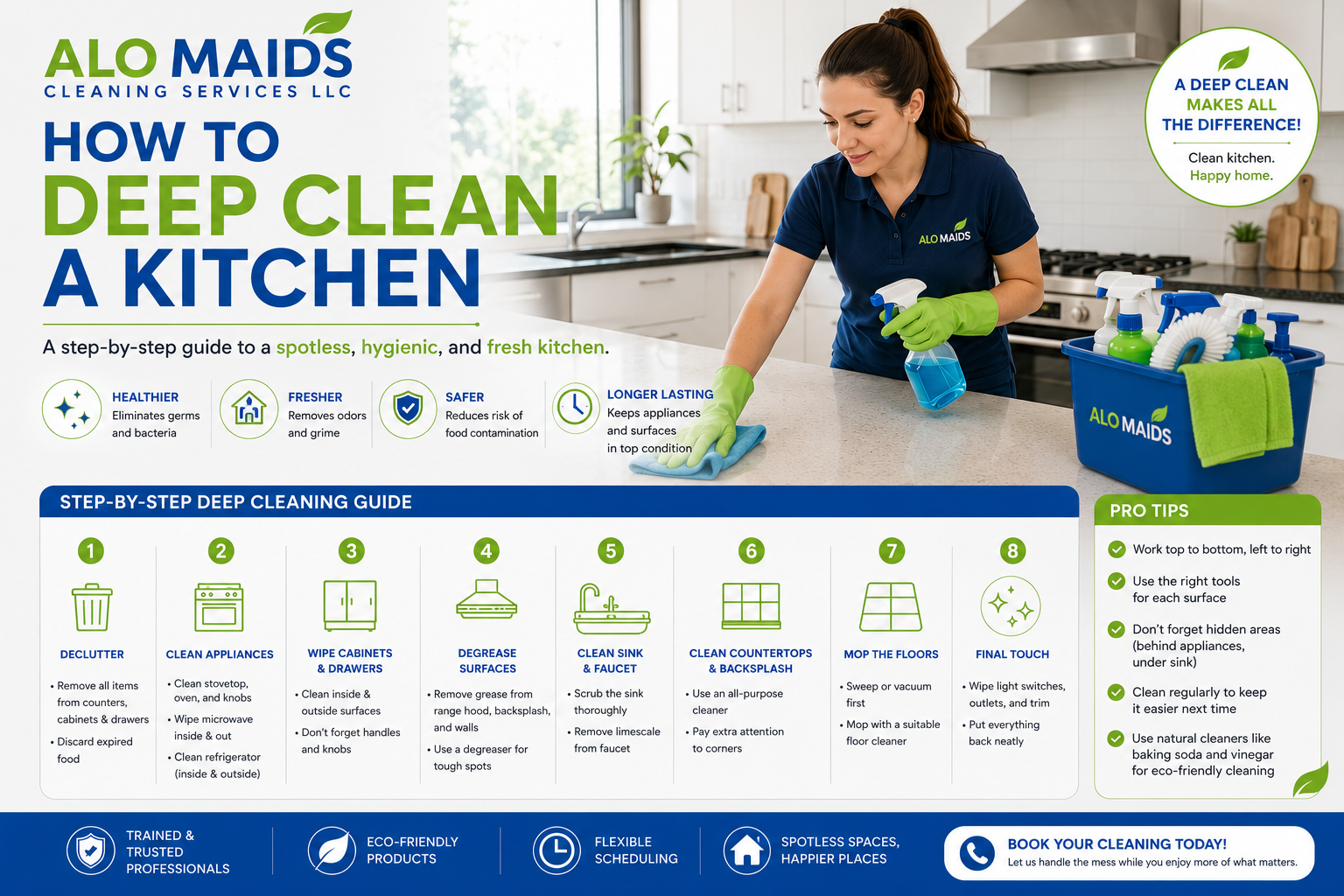
Work from the top of the kitchen down to the floor, and clean the inside of appliances before the outside. This order stops dust and grease from resettling on surfaces you have already cleaned.
Step 1: Clear and Declutter Every Surface
Remove everything from counters, the top of the fridge, and open shelving before cleaning begins. This lets you clean the full surface area rather than working around items.
Direct answer: clearing surfaces first prevents you from missing patches of grease hidden under bottles, jars, or small appliances.
Step 2: Deep Clean Inside the Oven and Hob
Apply a degreaser to the oven interior and let it sit for 15–20 minutes before scrubbing, following the product’s instructions. Remove hob grates and burner caps and soak them separately in hot, soapy water while the oven degreaser works.
- Remove oven racks and soak in warm soapy water.
- Apply degreaser to oven walls, base, and door glass.
- Leave to dissolve baked-on grease for 15–20 minutes.
- Scrub with a non-abrasive pad, then wipe clean with a damp cloth.
- Replace racks once fully dry.
A build-up of baked-on grease in the oven is one of the top reasons kitchens fail a visual hygiene check during move-out inspections in Dubai.
Step 3: Clean Inside the Refrigerator and Freezer
Remove all food, then wipe every shelf, drawer, and door seal with warm water and a mild detergent. Pay particular attention to the vegetable drawer, which NSF International identified as one of the germiest zones in a typical kitchen, sometimes harbouring Salmonella and Listeria.
- Empty the fridge and check expiry dates as you go.
- Remove shelves and drawers where possible and wash separately.
- Wipe door seals, where mould commonly collects in humid climates.
- Dry all surfaces before replacing food, to prevent condensation build-up.
Step 4: Degrease Cabinets, Handles, and the Extractor Fan
Wipe cabinet exteriors with a degreaser, paying extra attention to areas near the hob where grease vapour settles over time. Remove and soak extractor fan filters separately, since these trap the heaviest grease in the kitchen.
Direct answer: extractor fan filters need soaking, not wiping, because grease bonds to the mesh over weeks of cooking.
Handles, switches, and cabinet edges are touched constantly and deserve disinfectant rather than just soapy water.
Step 5: Sanitise the Sink, Taps, and Drains
Scrub the sink basin with a non-abrasive cleaner, then disinfect the taps, drain cover, and surrounding counter. The CDC’s food safety guidance notes that sink basins were the most contaminated surface in a 2023 USDA observational study, more so than counters or cutting boards.
- Scrub the basin and plughole with a bristle brush.
- Run baking soda followed by hot vinegar through the drain to reduce odour and bacterial build-up.
- Disinfect tap handles last, since hands touch these constantly during cleaning.
Step 6: Wash Cutting Boards, Utensil Holders, and Small Appliances
Wash cutting boards in hot, soapy water and sanitise them, particularly if they were used for raw meat, poultry, or seafood. Replace the sponge used for this step weekly, since NSF International’s research found the average kitchen sponge to be one of the most bacteria-dense items in the home.
Step 7: Clean Floors and Grout Last
Sweep or vacuum the floor before mopping with a disinfectant solution, working from the corners of the room toward the door. Grout lines between tiles trap grease and dust in Dubai kitchens faster than sealed surfaces, so scrub these with a grout brush during a deep clean.
Cleaning floors last stops dust and cleaning residue from other steps settling on a freshly mopped surface.
How Often Should You Deep Clean a Kitchen in Dubai?
Deep clean a Dubai kitchen every four to six weeks for households that cook daily, and every two to three months for lighter use. Dubai’s dust levels and AC-driven air circulation mean kitchens accumulate grime faster than in temperate climates.
| Household type | Recommended deep clean frequency |
|---|---|
| Daily home cooking | Every 4–6 weeks |
| Occasional cooking | Every 2–3 months |
| High-frying / heavy oil use | Every 3–4 weeks |
| Rental move-out | Before every tenancy change |
Should You Deep Clean a Kitchen Yourself or Hire a Professional?
DIY deep cleaning works for households with time and the right products, while professional cleaning suits kitchens with heavy grease build-up, tight schedules, or move-out requirements. A professional team also carries commercial-grade degreasers not typically sold for home use.
Alo Maids has completed deep cleans across more than a decade of operating in Dubai’s residential cleaning market, working in villas, apartments, and serviced residences across Downtown, Marina, and the Palm. One recurring pattern the team sees: extractor fan filters and oven interiors are the two areas homeowners underestimate most, and the two areas that take up the largest share of appointment time.
Trained teams also follow structured checklists that align with the hygiene principles set out in the Dubai Municipality Food Code, which governs cleaning, disinfection, and contamination-prevention standards for food preparation areas across the Emirate.
Frequently Asked Questions
How long does it take to deep clean a kitchen?
A thorough kitchen deep clean typically takes three to five hours, depending on the size of the kitchen and how much grease has built up. Ovens and extractor fans usually take the longest, since baked-on grease needs time to dissolve before scrubbing.
What is the difference between cleaning and deep cleaning a kitchen?
Regular cleaning covers visible surfaces like counters and floors. Deep cleaning covers hidden areas too — inside the oven, behind appliances, inside cabinets, and extractor fan filters — removing grease and bacteria that daily wiping misses.
What household item carries the most bacteria in the kitchen?
The kitchen sponge, according to research by NSF International, which found sponges consistently ranked as the most bacteria-dense item tested across sampled homes. Replacing sponges weekly and microwaving damp sponges for two minutes reduces bacterial load significantly.
How often should a kitchen be deep cleaned in Dubai?
Households that cook daily should deep clean every four to six weeks. Lighter-use kitchens can extend this to every two to three months, though Dubai’s dust and humidity levels mean waiting longer often leads to tougher, more time-consuming cleans.
Can I deep clean a kitchen with normal household products?
Basic deep cleaning is possible with degreaser, disinfectant, baking soda, and vinegar. However, heavily baked-on grease in ovens or extractor filters often responds better to commercial-grade degreasers, which professional cleaning teams typically carry.
Do I need to clean inside the refrigerator during a kitchen deep clean?
Yes. The refrigerator’s vegetable and meat compartments have been identified by NSF International as among the germiest zones in a home, sometimes carrying Salmonella, Listeria, or E. coli. These should be emptied and washed during every deep clean.
Why does grease build up faster in Dubai kitchens?
Dubai’s combination of fine outdoor dust, high humidity, and constant AC circulation speeds up the rate at which grease and dust settle on kitchen surfaces, compared with drier or less dusty climates.
Is it worth hiring a professional for a kitchen deep clean?
Hiring a professional saves time and typically covers areas homeowners skip, such as extractor filters and oven interiors. It also suits move-out cleans, where hygiene standards need to meet landlord or tenancy expectations quickly.
Author
Written by the Alo Maids cleaning team, who have carried out residential deep cleans across Dubai for over a decade, covering apartments, villas, and serviced residences. The team follows structured, checklist-based processes informed by CDC food safety guidance and Dubai Municipality hygiene standards.